
When we think about changing our diet or trying to live a healthier lifestyle, we often get overwhelmed by complicated rules. We see people counting every single calorie, weighing their food on tiny scales, or trying to memorize which foods have the lowest glycemic index. While those methods can work for some, they often make eating feel like a chore rather than a joy. For most of us, the best way to improve our health is to find a system that is easy to understand, quick to use, and flexible enough to work whether we are at home, at a restaurant, or at a holiday party. This is where the balanced plate method for healthy eating becomes a true game-changer. It is a visual tool that takes the guesswork out of nutrition, allowing you to build a perfect meal in seconds without ever needing a calculator or a complicated app.
The beauty of this approach lies in its simplicity. Instead of focusing on what you should remove from your life, it focuses on how you should arrange what you are already eating. The human body requires a specific mix of nutrients to function at its peak. We need fiber for digestion, protein for muscle repair, and healthy carbohydrates for energy. When we eat these things in the wrong proportions like a giant bowl of pasta with only a tiny bit of sauce our blood sugar spikes and then crashes, leaving us feeling tired and hungry an hour later. However, when you use the balanced plate method for healthy eating, you ensure that your body gets a steady stream of energy. This balance keeps you full longer, reduces cravings for sugary snacks, and provides your brain with the fuel it needs to stay sharp throughout the day.
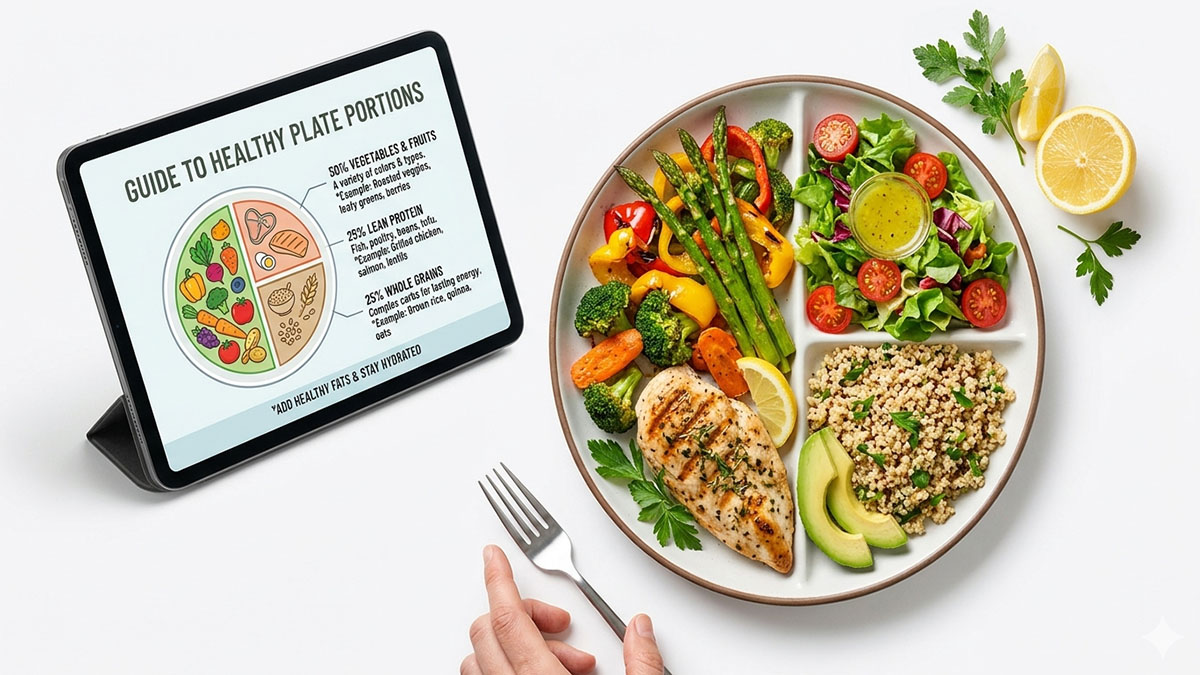
To start using this method, all you have to do is look at your plate and imagine a line right down the middle. One half of that plate should be dedicated entirely to non-starchy vegetables. This is the most important part of the strategy. Vegetables like spinach, broccoli, peppers, carrots, cauliflower, and green beans are packed with vitamins, minerals, and water. Because they are high in fiber but low in calories, they add bulk to your meal, which physically fills up your stomach. This tells your brain that you are full without the heavy feeling that comes from eating too much processed food. By making half your plate green or colorful, you are automatically lowering the calorie density of your meal while drastically increasing its nutritional value.
Now, let’s look at the other half of your plate. You want to divide this remaining half into two equal sections. In the first section, you will place your lean protein. Protein is the building block of the body. It helps you maintain muscle mass, supports your immune system, and is the most satiating of all the macronutrients. Good choices for this section include grilled chicken, turkey, fish, eggs, tofu, or beans. If you are a plant-based eater, lentils and chickpeas are fantastic options here as well. The balanced plate method for healthy eating reminds us that we don’t need a massive steak to be healthy; a portion roughly the size of the palm of your hand is usually exactly what the body needs to stay strong and recover from daily activities.
The final quarter of your plate is reserved for carbohydrates, specifically complex carbohydrates or starchy vegetables. Carbohydrates have received a bad reputation in recent years, but they are actually your body’s preferred source of fuel. The trick is to choose the right kind and keep them in the right proportion. Instead of white bread or sugary cereals, try to fill this quarter of your plate with whole grains like brown rice, quinoa, oats, or whole-wheat pasta. You can also use this space for starchy vegetables like potatoes, corn, or peas. By limiting these foods to one-quarter of the plate, you get the energy you need to power through your afternoon without overdoing it. This balance prevents that “food coma” feeling that often happens after a very heavy, carb-focused lunch.
Of course, no meal is complete without a small amount of healthy fats. Fats are essential for absorbing certain vitamins and for keeping your skin and hair healthy. While they don’t have a designated “section” on the plate, they should be used as accents. This might mean cooking your vegetables in a little bit of olive oil, adding a few slices of avocado on top of your protein, or sprinkling some seeds over your salad. Because fat is very calorie-dense, you only need a small amount about the size of your thumb to get the benefits. The balanced plate method for healthy eating encourages you to include these fats because they make the food taste better and help satisfy your taste buds, which makes you less likely to go looking for a dessert after you finish your meal.
One of the biggest advantages of this method is its incredible versatility. It works for every type of cuisine in the world. If you are eating Mexican food, you can fill half your plate with a fresh salad or sautéed peppers and onions, a quarter with seasoned beans or grilled chicken, and the last quarter with a small scoop of brown rice or a couple of corn tortillas. If you are at an Italian restaurant, you can ask for a large side of steamed broccoli or a big garden salad to take up half the plate, then have a small portion of pasta and a piece of grilled fish. It turns every meal into a simple logic puzzle that you can solve in your head. You don’t have to be “perfect” every time, but having this visual guide in your mind helps you make better choices more often.
Another reason why the balanced plate method for healthy eating is so successful for long-term weight management is that it doesn’t feel like a “diet.” Most diets fail because they are based on deprivation. They tell you that you can never have bread again or that you must fast for 20 hours a day. This creates a cycle of hunger and frustration that eventually leads to binge eating. The plate method is different because it is inclusive. It allows you to eat all the food groups. It teaches you about portions and balance rather than restriction. When you know that you can have a little bit of everything, the psychological pressure of “dieting” disappears, and you can focus on how the food actually makes your body feel.
For families with children, this is also the best way to teach kids about nutrition without making them obsessed with numbers. You can simply show a child that their plate should look like a rainbow and that different parts of the plate do different jobs for their body. The “green part” makes them stay healthy and not get sick, the “protein part” makes them grow tall and strong, and the “grain part” gives them the energy to run and play. Using the balanced plate method for healthy eating creates a positive relationship with food from a young age, focusing on what food gives to the body rather than what it takes away. It turns the dinner table into a place of education and health rather than a place of conflict.
In conclusion, health doesn’t have to be complicated. You don’t need a degree in nutrition or a library of cookbooks to eat well. All you really need is a standard-sized dinner plate and a basic understanding of how to fill it. By prioritizing vegetables, choosing lean proteins, and being mindful of your carbohydrate portions, you are doing more for your long-term health than any fad diet ever could. The balanced plate method for healthy eating is a sustainable, realistic, and effective way to nourish your body every single day. Start with your next meal take a look at your plate, move things around until the proportions look right, and enjoy the feeling of a body that is well-fed and perfectly balanced. Your journey to wellness is just one plate away.